Automatic Folder Compression on Windows
Set up automatic folder compression on Windows so new JPEG, MP4, and PDF files compress when they land in a watch folder. Local presets, no upload step.
The export finishes at 6 PM. By Monday the shared drive holds forty new PNG UI shots, six MOV bug clips, and three scan PDFs nobody resized. You could drag each batch into a compressor every morning, or you could point a watch folder at C:\Exports\web and let the same preset run while you start the day.
Automatic folder compression on Windows makes sense when files land in the same directory on a predictable schedule and the output spec does not change job to job.
Method 1: GetCompress folder monitoring
Best for: “New file appeared” jobs with a stable preset (web JPEG, Teams MP4, email PDF).
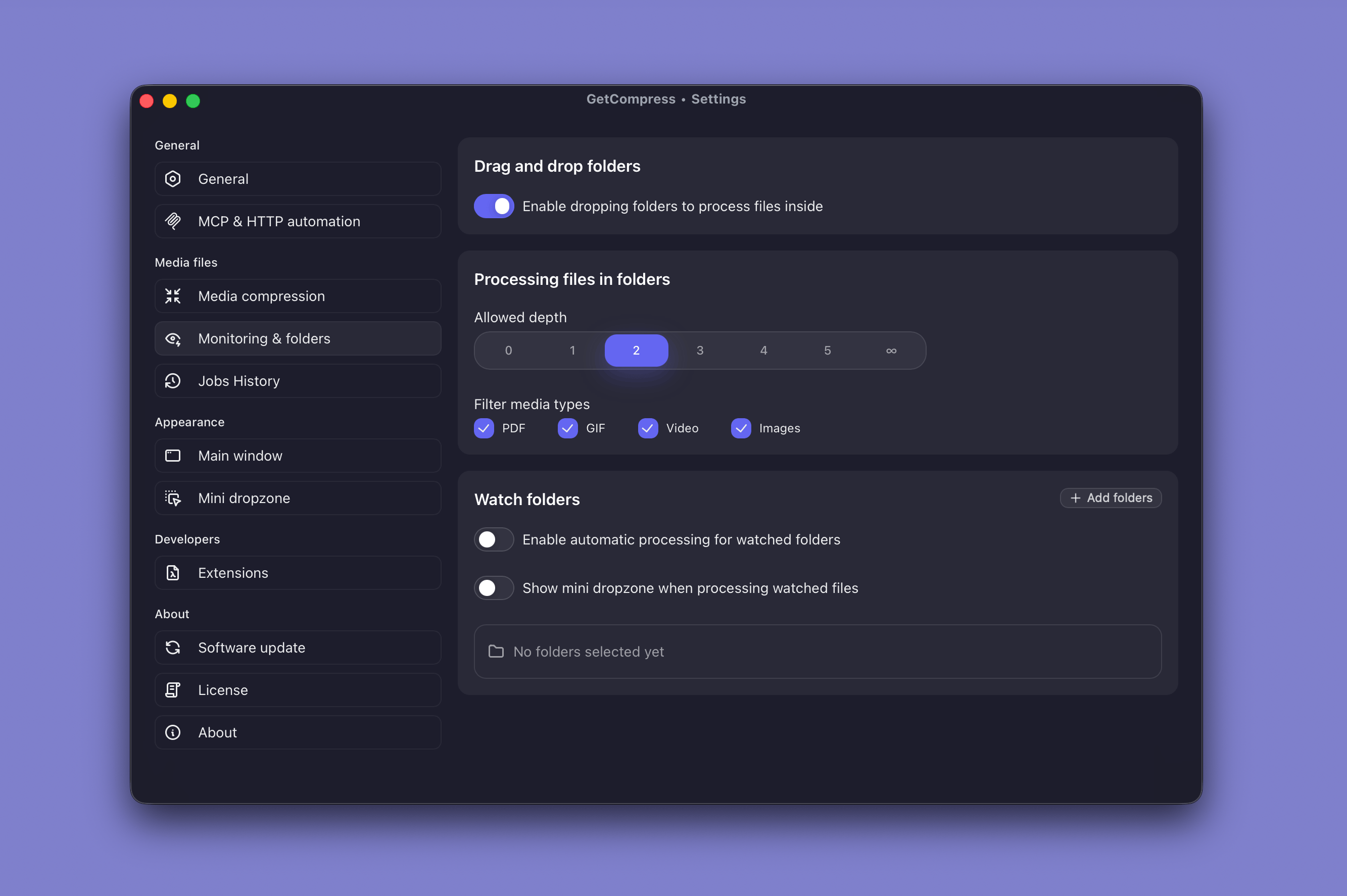
- Open GetCompress and save a preset for the destination (for example “Web JPEG 1920” or “Teams MP4 720p”).
- Turn on folder monitoring in settings.
- Pick a watch folder and attach that preset.
- Choose an output folder that is not the same as the watch path.
- Drop three test files, check size and quality, then point production exports at the watch folder.
Processing stays on your PC. Use target file size on video when portals cap megabytes. Exact target size is video only.
When folder monitoring beats manual batch
| Signal | Example |
|---|---|
| Same folder every week | Render output directory |
| Trigger is “file appeared” | Phone sync folder, screen capture directory |
| Settings stable for a month | Web JPEG 1920 px, Teams MP4 720p |
| Shared PC | One preset name everyone recognizes |
If the pain is a one-time email bounce, read the email attachment size limits guide first. You may only need a single batch run, not permanent monitoring.
Stop monitoring when every job needs different codecs. Automation fails when “smaller” is vague and the preset drifts. Write down max width, quality, codec, and output path before you enable the watch folder.
Common watch folder setups
| Watch folder | Preset | Result |
|---|---|---|
C:\Exports\web | Web JPEG 1920 px | Ready for CMS upload |
C:\Videos\Captures | MP4 1080p | Smaller bug repro clips |
C:\Documents\Scans\in | PDF medium | Lighter attachments |
C:\Downloads\heic-ingest | HEIC to JPEG 3000 px | Listing-ready stills |
Output goes to a sibling folder you pick (C:\Exports\web\out, for example). Originals stay in the watch folder unless your workflow moves them after success.
For one-time folder batches without ongoing watches, see the batch compress and convert guide for Windows .
Presets that survive automation
| Preset field | Write it down |
|---|---|
| Max width / height | 1920 px long edge for web |
| Video resolution | 1080p vs 720p for ticket clips |
| Target file size (video) | 15 MB cap when email is the destination |
| Output format | JPEG, MP4, compressed PDF |
| Output directory | Avoid overwriting sources |
Name presets for the destination, not the mood: “Teams MP4 720p 15MB”, not “small video”. Start with one watch folder and one preset. Add a second path only when the first is stable for a month.
Method 2: Task Scheduler, PowerShell, or FFmpeg
Windows teams automate with Task Scheduler jobs or PowerShell scripts that call FFmpeg on a schedule or at logon.
| Tool | Strength | Maintenance |
|---|---|---|
| Task Scheduler | Auditable scheduled jobs | Paths break when projects move |
| PowerShell + FFmpeg | Full control | Someone owns codec flags |
| FileSystemWatcher script | ”New file” trigger | Error handling is on you |
| GetCompress monitoring | Preset UI, preview, mixed media | Enable in app settings |
Task Scheduler fits clock-based runs (every Friday at 6 PM). GetCompress folder monitoring fits event-based runs (“file appeared in ingest folder”) without wiring FileSystemWatcher in PowerShell.
Keep a manual fallback (drag-and-drop into GetCompress) for deadline weeks when a scheduled task fails silently.
Avoiding duplicate and failed runs
| Problem | Fix |
|---|---|
| Same file processed twice | Move outputs elsewhere; do not watch the output folder |
| Partial writes | Wait until the export app finishes before files appear in the watch folder |
| Locked files | Screen recorder still writing; exclude temp extensions if needed |
| Wrong preset on mixed folder | Split ingest folders by media type |
Test on a copy folder first. Drop three representative files (PNG, MP4, PDF) and confirm output size and quality before you point production exports at the watch path.
Log failures when you also run shell automation (>> C:\Logs\compress.log 2>&1). Silent failures on Friday night exports are worse than a loud error on a test folder.
When a one-time batch is enough
Drag a folder into GetCompress, use Photos, or run a short PowerShell / FFmpeg loop when the job is a one-off email bounce or a single shoot.
GetCompress folder monitoring also helps when the same export path fills every week and the preset is documented. Processing stays local. It does not replace Task Scheduler for clock-based IT jobs, and it does not replace a full video editor. For the Mac watch-folder setup, see automatic folder compression on Mac .
- Batch Compress and Convert on WindowsBatch compress and convert on Windows with GetCompress, Task Scheduler, or PowerShell. Local presets for JPEG, MP4, and PDF folders.
- Reduce File Size on WindowsReduce file size on Windows for video, photos, PDF, and GIF with GetCompress, Photos or Clipchamp, and FFmpeg. Free space without deleting project masters.
- MCP automation on WindowsLet Cursor or Claude Desktop run local compress tools on Windows through MCP, including GetCompress.
- Automatic Folder Compression on MacSet up automatic folder compression on Mac so new JPEG, MP4, and PDF files compress when they land in a watch folder. Local presets, no upload step.