How to Compress PDF on Windows: 3 Methods
Compress PDF on Windows with GetCompress, PowerPoint re-export, or Ghostscript. Shrink decks and scans for Outlook and portals.
A 40-slide deck can be 30 MB even when the text is light. Embedded images carry the weight. Outlook blocks attachments and vendor portals time out long before anyone reads the content.
Three solid routes cover most Windows jobs: GetCompress for batches and presets, PowerPoint re-export when you still have the deck, and Ghostscript when you need a controlled pass on scans.
Method 1: GetCompress
Best for: Folders of decks, scans, and reports that share the same optimization every week. Local processing matters for contracts and unreleased materials.
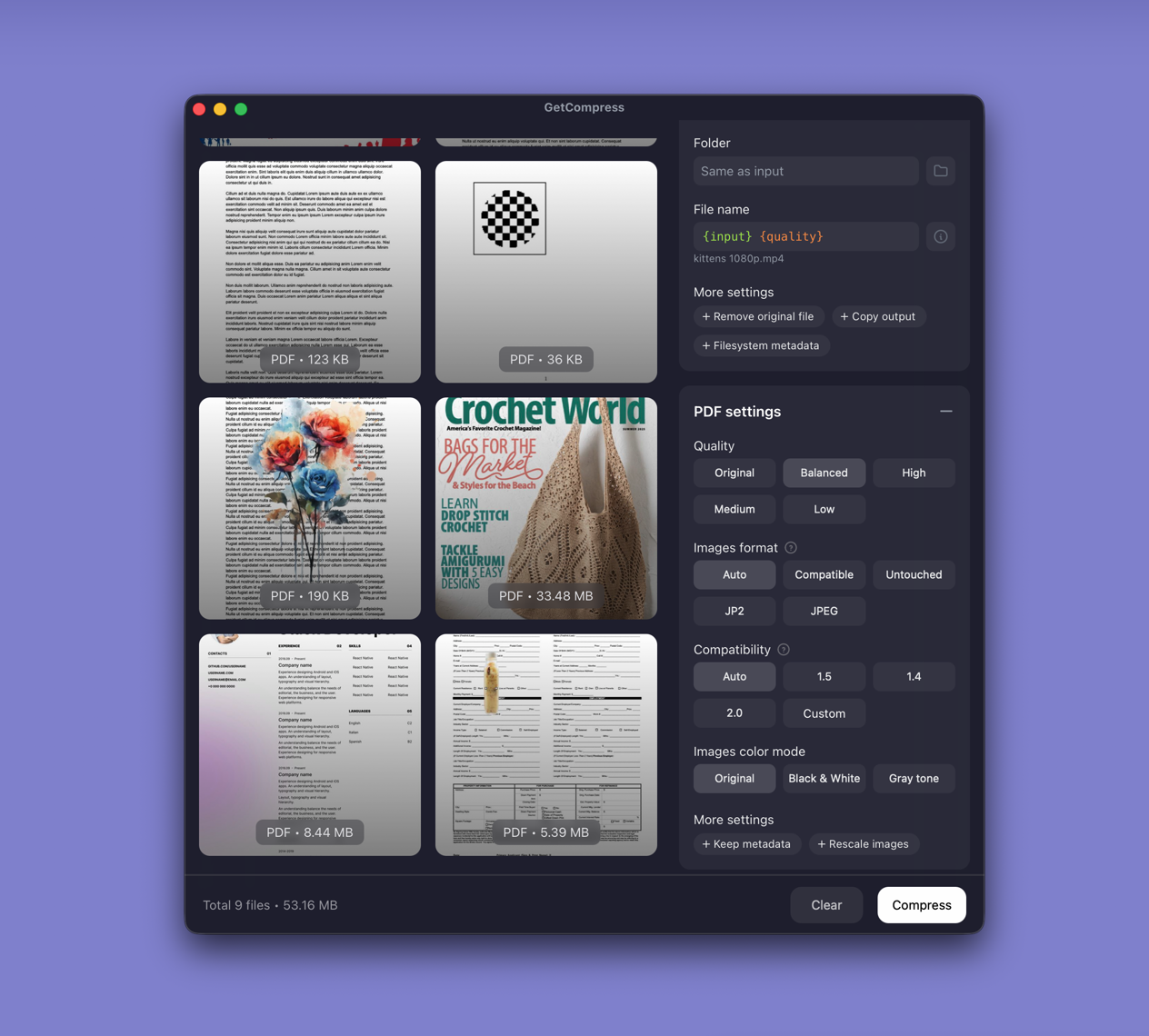
- Open GetCompress and drop one PDF or a folder into the queue.
- Pick a PDF compression preset. GetCompress optimizes embedded images inside the file.
- Preview a chart-heavy or signature page when small type matters.
- Export a new copy; keep the master.
Save the preset so the next compress pass is one click. PDF compression does not use an exact megabyte target file size. That control is video-only. Use quality and image optimization, then check File Explorer size against your email or portal limit.
Method 2: Re-export from PowerPoint
Best for: Decks you still have as PPTX.
- Open the file in PowerPoint.
- File → Export → Create PDF/XPS Document.
- Pick Minimum size (publishing online) for screen viewing, or Standard when charts need sharper lines.
Zoom charts and small type. If it looks muddy, re-export at higher quality instead of over-compressing. Keep a print-quality PDF in archive storage, not in the email copy.
When reviewers need individual pages, see PDF to images on Windows . For scan merges, see JPG to PDF on Windows .
Limitation: Needs the editable source. Vendor PDFs without a deck skip this method.
Method 3: Ghostscript for scans
Best for: Image-heavy scan PDFs when you need a CLI profile and can compare pages carefully.
Prefer re-scanning at 150 to 200 DPI when you control the source. Microsoft Print to PDF is a last resort; quality loss is hard to predict.
Install Ghostscript with winget, then:
winget install ArtifexSoftware.GhostScript
gswin64c -sDEVICE=pdfwrite -dCompatibilityLevel=1.4 -dPDFSETTINGS=/ebook `
 -dNOPAUSE -dQUIET -dBATCH -sOutputFile=compressed.pdf input.pdf
Compare one page with signatures or fine print in Edge before you batch the rest. When scans arrive as JPEG files, resize in Photos before Print to PDF so the merge starts smaller.
Limitation: You maintain the commands. Easy to over-soften text if you jump straight to aggressive profiles.
Which method should you use
| Situation | Start here |
|---|---|
| Folder of PDFs, recurring preset, local-only | GetCompress |
| You still have the PowerPoint file | Re-export |
| Scan PDF with CLI control | Ghostscript |
| Destination | Typical limit | Practical starting point |
|---|---|---|
| Corporate email | 10 to 25 MB | Aim under 8 MB for headroom |
| Web portals | 5 to 20 MB | Compress before upload; keep a master |
| Print vendors | Often no strict cap | Send the uncompressed master |
Name the compressed copy clearly in File Explorer so you do not attach the master by mistake.
Why PDFs get large
Most bloat is raster images saved at print resolution inside a file meant for screens. Text and vectors stay small; photos, slide bitmaps, and scans dominate.
| PDF type | Usual cause | Try first |
|---|---|---|
| Exported slides | Full-size image per slide | PowerPoint online-size export |
| Scans | High DPI on every page | Re-scan at 150 to 200 DPI, or compress |
| Photo inserts | Large JPEG embedded | Optimize, then check charts |
If you merge many JPEG scans, compress after merge. Each photo can look fine alone and still blow the attachment limit together.
When PowerPoint re-export is enough
PowerPoint re-export can finish a single deck when Minimum size clears the limit and text stays sharp.
GetCompress also covers quarterly report folders, scan batches, the same preset, or sensitive files you will not upload to a browser tool. It does not replace PowerPoint. For broader cleanup, see reduce file size on Windows .
- Convert JPG to PDF on WindowsCombine JPG images into one PDF on Windows with Microsoft Print to PDF, set page order, then shrink the file if Outlook or a portal rejects it.
- Export PDF to Images on WindowsTurn PDF pages into PNG or JPEG on Windows with Edge, pdftoppm, or a resize pass in GetCompress. Batch slide decks without online splitters.
- How to Compress PDF on MacCompress PDF on Mac with GetCompress, Preview Reduce File Size, or a Keynote re-export. Shrink decks and scans for email and portals.
- Reduce File Size on WindowsReduce file size on Windows for video, photos, PDF, and GIF with GetCompress, Photos or Clipchamp, and FFmpeg. Free space without deleting project masters.