Convert AVCHD to MP4 on Mac: 3 Methods
Convert AVCHD to MP4 on Mac with GetCompress, QuickTime, or FFmpeg. Remux or re-encode MTS clips for editing and uploads.
AVCHD footage from Sony, Panasonic, and Canon camcorders arrives as MTS or M2TS files inside a dated folder structure. Editors, upload forms, and collaborators expect plain MP4 instead.
You notice when Final Cut imports slowly, when a client portal rejects MTS, or when you need to share one interview clip without handing over an entire PRIVATE card dump. Three solid routes cover most Mac jobs: GetCompress for batch cards, QuickTime for one clip, and FFmpeg for Terminal remux.
AVCHD vs MP4
AVCHD is a camcorder format that stores H.264 video (often AVC High Profile) with AC-3 or AAC audio in MTS containers on disc or SD cards. MP4 is the same codec family in a container every app accepts.
| AVCHD (MTS) | MP4 | |
|---|---|---|
| Common source | Consumer camcorders, event videography | Web, phones, editors |
| Folder layout | Nested AVCHD / BDMV structure | Single files |
| Upload forms | Often rejected | Usually accepted |
| Best first step | Remux or re-encode to MP4 | Already compatible |
Because the video is often already H.264, remux with -c copy is fast when audio codecs cooperate. When editors choke on AC-3 or interlaced flags, re-encode audio to AAC and deinterlace if needed.
See HEVC to H.264 on Mac when your camcorder exports HEVC instead. When size limits matter, see the video compression guide .
Method 1: GetCompress
Best for: event offloads, full card copies, and portals that list a hard megabyte cap.
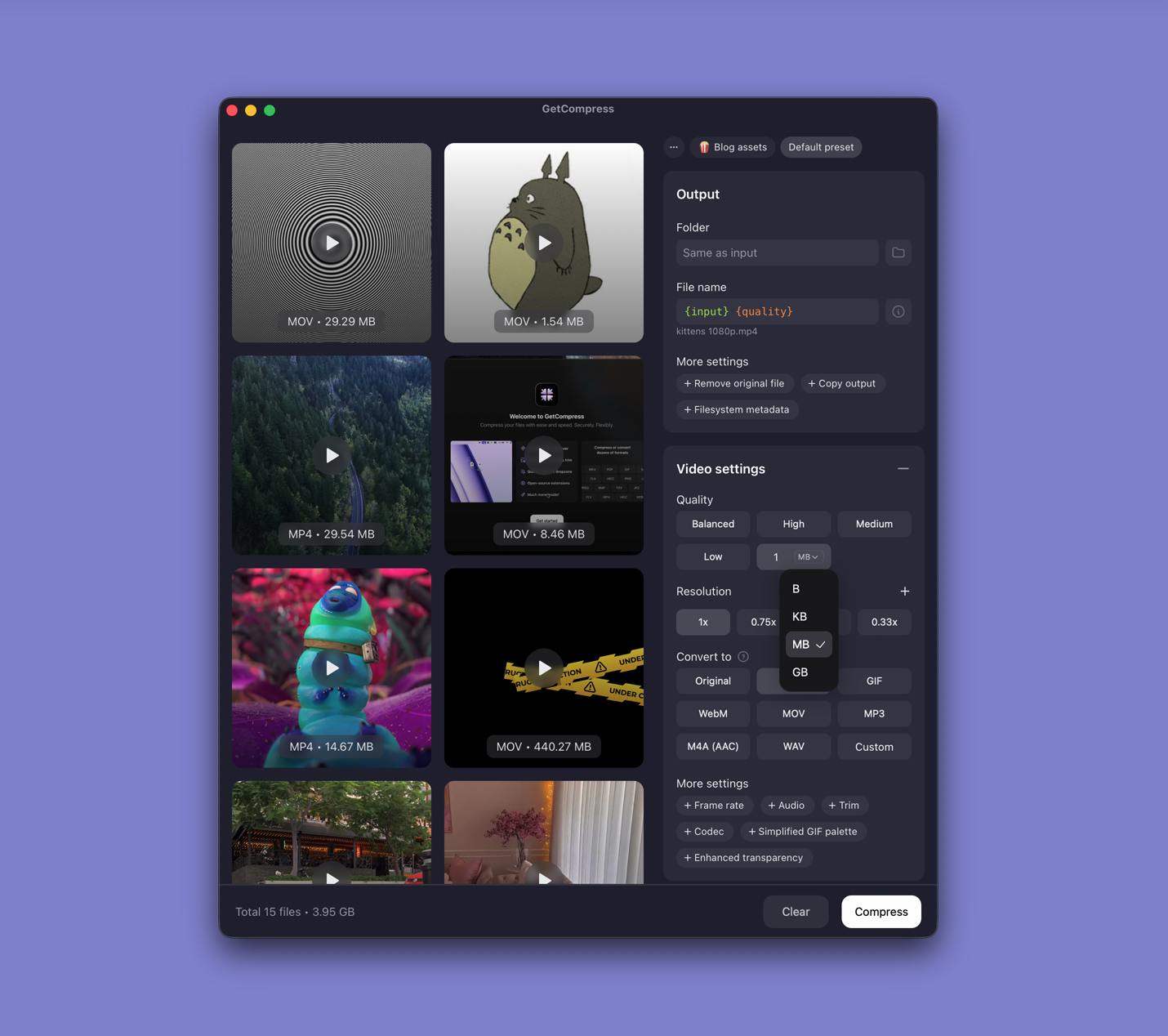
- Copy MTS files out of the nested AVCHD tree into a plain folder.
- Open GetCompress and drop the folder into the queue.
- Choose MP4 output, set resolution and quality, or set an exact target file size when the portal states a limit (video only).
- Trim in the preview if you only need one segment from a long take.
- Export, then upload or hand off the MP4 copies.
Save a preset such as “1080p client highlight” so you can reuse it next time. Folder monitoring can watch an offload folder after each card ingest.
Method 2: QuickTime
Best for: One highlight clip when you do not need a batch queue.
- Copy individual MTS files to a plain folder (not only the nested AVCHD tree).
- Open the clip in QuickTime Player.
- Edit → Trim (⌘T) to mark in and out points.
- File → Export As → 1080p (or 4K when the source is that resolution).
Export re-encodes, which takes longer than remux but produces a clean MP4 for sharing.
| Situation | Export choice |
|---|---|
| One highlight for a client | 1080p after trim |
| Full interview | 1080p, trim dead air first |
| Portal with a hard MB cap | 720p export or compress after |
Limitation: QuickTime does not batch an entire event card.
Method 3: FFmpeg in Terminal
Best for: Remux speed, folder loops, and interlaced sources.
Install FFmpeg with Homebrew if needed:
brew install ffmpegFast remux when video is already H.264:
ffmpeg -i input.mts -c copy -movflags +faststart output.mp4When audio fails or editors reject the file, re-encode audio to AAC:
ffmpeg -i input.mts -c:v copy -c:a aac -b:a 192k -movflags +faststart output.mp4Full re-encode for maximum compatibility:
ffmpeg -i input.mts -c:v libx264 -crf 20 -preset medium \
 -c:a aac -b:a 192k -movflags +faststart output.mp4
Batch every MTS in a folder:
mkdir mp4-out
for f in *.MTS *.mts; do
 [ -f "$f" ] || continue
 ffmpeg -i "$f" -c copy -movflags +faststart \
 "mp4-out/${f%.*}.mp4" 2>/dev/null || \
 ffmpeg -i "$f" -c:v libx264 -crf 20 -preset medium \
 -c:a aac -b:a 192k -movflags +faststart \
 "mp4-out/${f%.*}.mp4"
done
For interlaced AVCHD, add -vf yadif before libx264 if you see combing on motion. For MOV exports from newer cameras, see MOV to MP4 on Mac .
Limitation: You maintain the commands yourself.
Which method should you use
| Situation | Start here |
|---|---|
| Full card, recurring events, or MB cap | GetCompress |
| One QuickTime-friendly clip | QuickTime |
| Remux scripts or interlaced flags | FFmpeg |
When a QuickTime export is enough
QuickTime can finish a single highlight when the exported MP4 lands under the limit after a trim and a 1080p or 720p export.
GetCompress also helps when you offload many MTS clips after each event, need a reusable preset, or must hit an exact video target file size. Processing stays on your Mac. It does not replace Final Cut or Premiere. For the Windows workflow, see AVCHD to MP4 on Windows .
- Convert MOV to MP4 on MacConvert MOV to MP4 on Mac with GetCompress, QuickTime, or FFmpeg. Get H.264 MP4 for uploads, Windows teammates, and size-limited portals.
- Convert HEVC to H.264 on MacConvert HEVC to H.264 on Mac with GetCompress, QuickTime, or FFmpeg. H.264 MP4 for older devices, Windows teammates, and upload tools.
- How to Compress Video on MacCompress video on Mac with GetCompress, QuickTime, or FFmpeg. Trim first, pick 720p or 1080p, and hit email or upload size limits without guessing.
- Convert AVCHD to MP4 on WindowsConvert AVCHD to MP4 on Windows with GetCompress, Clipchamp, or FFmpeg. Remux or re-encode MTS clips for editing and uploads.