Convert Video to MP4 on Mac: 3 Methods
Convert video to MP4 on Mac with GetCompress, QuickTime, or FFmpeg. Get H.264 MP4 for uploads, editing, and sharing from MOV, MKV, and more.
Upload forms, editors, and teammates often expect MP4 with H.264 video and AAC audio. Your source may arrive as MOV, MKV, WMV, FLV, AVI, WebM, or MTS. Converting locally fixes compatibility without re-shooting and keeps sensitive footage off random upload sites.
Why convert to MP4
MP4 is a container, not a single codec. Most “convert to MP4” jobs mean: put H.264 (or sometimes HEVC) video and AAC audio inside a .mp4 file that web tools recognize.
| Source | Typical issue | MP4 outcome |
|---|---|---|
| MOV, M4V | Extension filtered by a form | Same codecs, familiar extension |
| MKV, WebM | Editor or portal rejects container | H.264 + AAC in MP4 |
| WMV, FLV, AVI | Legacy codecs or containers | Modern H.264 profile |
| MTS (AVCHD) | Nested card folders | Flat MP4 files |
Dedicated paths: MOV to MP4 , MKV to MP4 , WMV to MP4 , FLV to MP4 . When the blocker is megabytes, not extension, see how to compress video on Mac .
Method 1: GetCompress
Best for: One file or mixed formats and batches: and “make it open and upload” jobs where you also care about size.
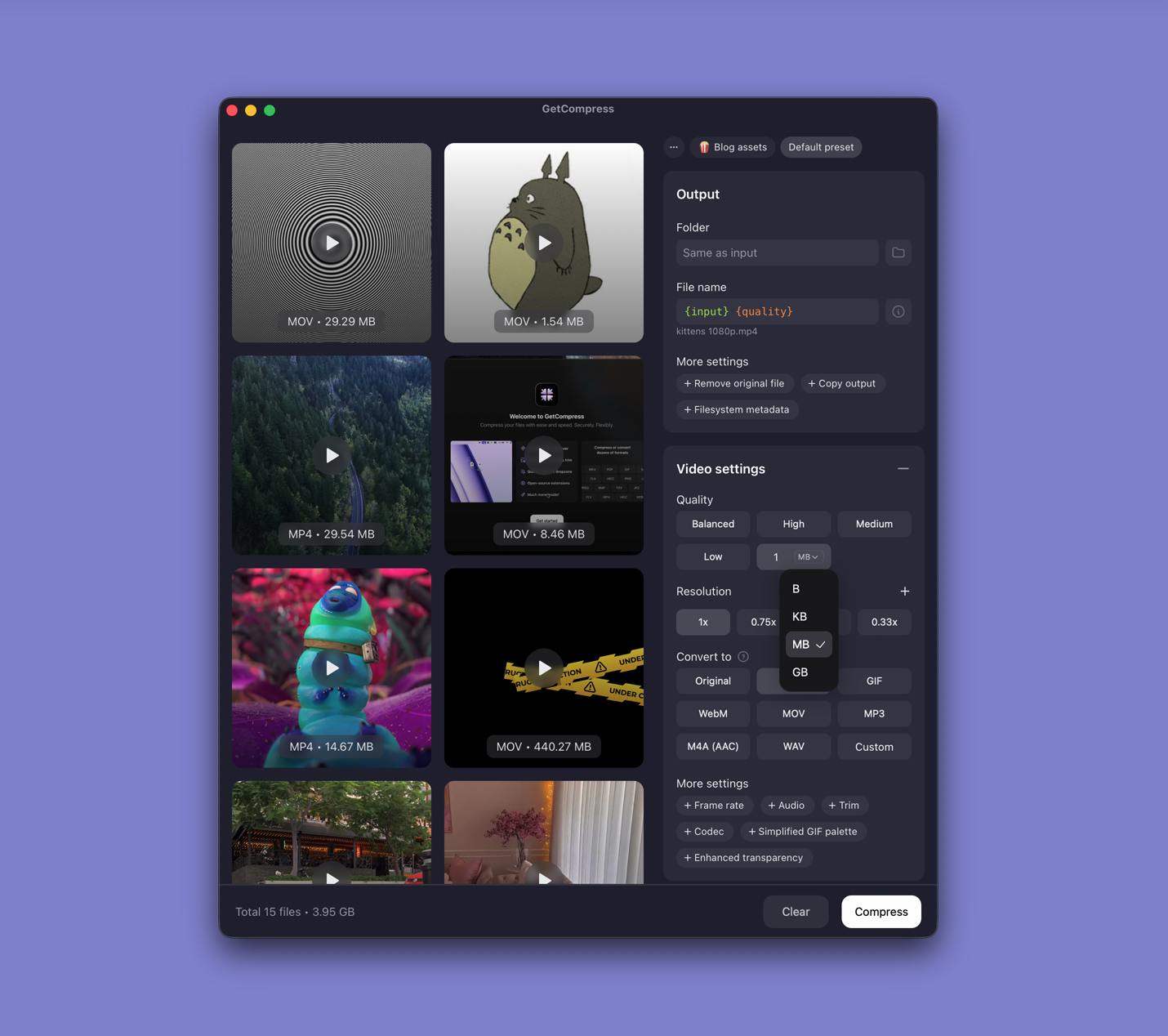
- Drop one file or a folder into GetCompress .
- Choose MP4 as the output format.
- Trim in preview if only part of the clip matters.
- Set a quality level (Original, High, Medium, Balanced, or Low) or resolution, or use target file size when the portal lists a megabyte cap.
- Export and drag the result into the upload field.
Processing stays on your Mac. Save a preset such as “1080p client review” so you can reuse it next time.
Method 2: Export in QuickTime
Best for: One or two files QuickTime already opens.
- Open the video in QuickTime Player.
- Edit → Trim (⌘T) if needed.
- File → Export As → 1080p (or 720p for chat and email).
That re-encodes to H.264 in an MP4-friendly file. QuickTime cannot open every legacy format (many FLV, WMV, and MKV files). When open fails, use Method 3.
Limitation: No batch for a mixed downloads folder. No typed megabyte target.
Method 3: Convert with FFmpeg
Best for: Formats QuickTime cannot open, remux when possible, and folder scripts.
brew install ffmpegUniversal re-encode:
ffmpeg -i input.any -c:v libx264 -crf 22 -preset medium \
 -c:a aac -b:a 128k -movflags +faststart output.mp4
Try remux first when the source is already H.264 + AAC:
ffmpeg -i input.mkv -c copy -movflags +faststart output.mp4If remux fails, fall back to the re-encode command. Batch common extensions:
mkdir mp4-out
for f in *.{mov,mkv,wmv,flv,avi,webm,m4v,mts}; do
 [ -f "$f" ] || continue
 ffmpeg -i "$f" -c:v libx264 -crf 22 -preset medium \
 -c:a aac -b:a 128k -movflags +faststart \
 "mp4-out/${f%.*}.mp4"
done| Flag | Plain meaning |
|---|---|
-crf 22 | Quality (lower = better, bigger; try 20 to 26) |
-preset medium | Speed versus compression tradeoff |
-movflags +faststart | Web-friendly metadata placement |
For HEVC to H.264 specifically, see convert HEVC to H.264 on Mac .
Limitation: You own the commands and error messages.
Which method should you use
| Situation | Start here |
|---|---|
| Mixed folder, recurring convert, or a size cap | GetCompress |
| One file QuickTime opens | QuickTime |
| Legacy format or automation | FFmpeg |
Remux when codecs already fit the destination. Re-encode when the player rejects the codec, when you change resolution, or when you need a smaller file.
When QuickTime alone is enough
If QuickTime opens the clip and one export produces a working MP4 under the size limit, you are done.
GetCompress also helps when sources change every project, when you batch a whole folder, or when conversion and compression belong in the same step. It does not replace FFmpeg for obscure formats or broadcast packaging. After conversion, if the MP4 is still too large, adjust quality or resolution in the same window rather than starting over.
- Convert MOV to MP4 on MacConvert MOV to MP4 on Mac with GetCompress, QuickTime, or FFmpeg. Get H.264 MP4 for uploads, Windows teammates, and size-limited portals.
- Convert MKV to MP4 on MacConvert MKV to MP4 on Mac with GetCompress or FFmpeg. Remux when codecs fit, or re-encode H.264 for QuickTime and uploads.
- Convert WMV to MP4 on MacConvert WMV to MP4 on Mac with GetCompress, QuickTime, or FFmpeg. Re-encode to H.264 for uploads, editing, and sharing.
- How to Compress Video on MacCompress video on Mac with GetCompress, QuickTime, or FFmpeg. Trim first, pick 720p or 1080p, and hit email or upload size limits without guessing.