Offline Media Compression on Mac
Compress images, video, and PDF on Mac without uploading to online tools. Local JPEG, MP4, and PDF processing for NDA work and slow connections.
Security review asks where the file goes. You are on hotel Wi-Fi with a 200 MB MOV that must land under 25 MB before tomorrow’s email. Uploading to a random compressor means copying unreleased footage to someone else’s server, waiting on upload and download, and hoping the site deletes the copy afterward. Offline compression keeps the file on your disk while it shrinks.
Why offline compression matters
| Scenario | Risk of online tools |
|---|---|
| NDA client exports | Third-party storage |
| Embargoed campaign assets | Leak before launch |
| HR or legal PDFs | Sensitive text leaves the device |
| Slow or metered connection | Upload time rivals encode time |
| Air-gapped edit bay | No reliable internet at all |
Online compressors can work for public blog images with no confidentiality angle. They are a poor default for unreleased product UI, signed contract scans, or bug repros with internal URLs on screen.
The GetCompress privacy guide explains what stays on your Mac during compression and what may use the network separately (updates, license checks). Compression itself does not upload your media. When the blocker is email size rather than privacy, see email attachment size limits .
What you can shrink locally
| Media | Common inputs | Typical offline output |
|---|---|---|
| Images | HEIC, PNG, JPEG, TIFF, WebP | JPEG, PNG, WebP |
| Video | MOV, MP4, MKV, screen captures | MP4 H.264 or HEVC |
| Documents | Scan PDF, export PDF | Compressed PDF |
| GIF | GIF, short MP4 loops | Optimized GIF or MP4 |
Convert and compress in one local pass when the recipient needs a different format, for example HEIC to JPEG for a Windows colleague. Batching forty files does not change the privacy model compared to processing one file.
Exact target file size is a video workflow. For images and PDF, use quality, dimensions, or preset levels instead.
Built-in Mac tools
| Tool | Offline? | Good for | Limits |
|---|---|---|---|
| Preview | Yes | Single PDF or image export | No video batch, no video target size |
| QuickTime | Yes | Trim and export one MOV | No folder queue |
| Photos | Yes | HEIC export | Slow for Finder folders |
| Terminal + FFmpeg | Yes | Scriptable transcode | You maintain flags |
Built-in tools cover one-off tasks. They thin out when you need mixed PNG + MP4 + PDF in one queue, a typed megabyte cap on video, or a watch folder on an ingest directory. Offline does not have to mean fully manual: saved presets and watch folders can still run without network access for the encode step.
Air-gapped and low-connectivity workflows
| Workflow | Offline tip |
|---|---|
| Edit bay with no internet | Install tools while online once; compress locally after |
| Travel day before client send | Queue exports in the hotel room without uploading masters |
| Secure facility | Prefer local tools over browser upload forms |
| Tethered phone data | Skip double transfer (up to cloud, down again) |
Prepare presets before you disconnect: email PDF medium, Slack MP4 720p, web JPEG 1920 px. Name them for the destination so you do not tweak settings on a slow link. Automation patterns for larger folders are covered in batch compress and convert on Mac .
Metadata still needs a policy
Local processing does not automatically strip sensitive metadata.
| Metadata type | Note |
|---|---|
| EXIF GPS | May remain on JPEG exports from phones |
| Camera serial | Often preserved unless you strip |
| PDF author field | Still visible in Inspector |
| Video creation date | Usually preserved |
Offline compression solves the upload problem. Metadata policy is still yours to define. Keep masters on an archive disk and compress copies for delivery.
Where GetCompress fits
For public assets with no confidentiality need, online tools remain an option. For everything else, local processing is the safer default.
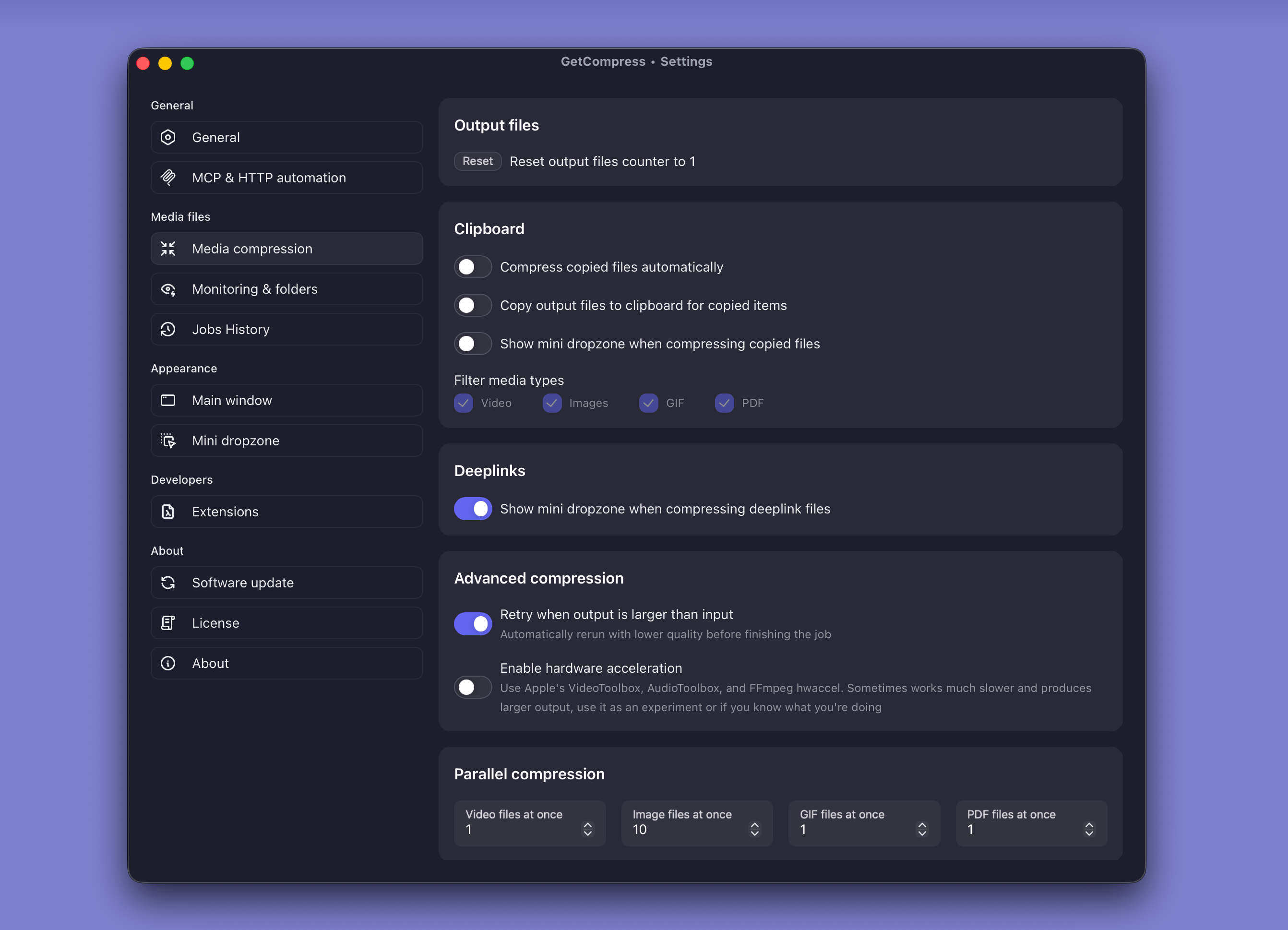
GetCompress runs compression on your Mac without an upload step for the encode. It helps when you need mixed media in one queue, reusable presets, video target file size, preview and trim, or folder monitoring on an ingest directory that fills while you work disconnected. MCP and a local HTTP automation server are available when agents should trigger the same offline presets on your machine.
It does not replace Final Cut, a records system, or a redaction workflow. When security forms ask where files go during compression, the honest answer for a local tool is your Mac’s disk. For a broader size cleanup across formats, see reduce file size on Mac .
- GetCompress privacyHow GetCompress processes files on your Mac with local-only encoding, when the app may use the network, and how that compares to Preview and online tools.
- Online compressor safetyWhat happens when you upload files to online compressors, and what to use on Mac instead with Preview, QuickTime, and GetCompress.
- Reduce File Size on MacReduce file size on Mac for video, photos, PDF, and GIF with GetCompress, Preview or QuickTime, and FFmpeg. Free space without deleting project masters.
- Offline Media Compression on WindowsCompress images, video, and PDF on Windows without uploading. Local JPEG, MP4, and PDF processing for NDA work, air-gapped PCs, and slow Wi-Fi.