Convert FLAC to MP3 on Windows: 3 Methods
Convert FLAC to MP3 on Windows with GetCompress or FFmpeg. Keep FLAC masters; export MP3 for legacy players and uploads.
You archived concerts and albums as FLAC. A legacy CMS, an LMS upload field, or an older car USB export wants MP3. The FLAC library stays lossless; delivery is a separate export step. Converting on your PC keeps unreleased recordings private.
FLAC vs MP3 on Windows
FLAC preserves the full rip. MP3 shrinks files with lossy compression and opens on nearly every Windows app from the last twenty years.
| Format | Size | Typical use on Windows |
|---|---|---|
| FLAC | Large | Archive, editing master |
| MP3 | Smaller | Legacy embeds, email, old hardware |
| M4A (AAC) | Smaller than MP3 at same quality | Modern players, Teams clips |
Default to M4A for new workflows unless something requires MP3. Keep FLAC in a read-only archive. Write MP3 exports to deliverables\mp3\. For broader audio compression, see compress audio files on Windows .
Method 1: GetCompress
Best for: Folder queues, consistent bitrate, and presets without writing PowerShell loops each time.
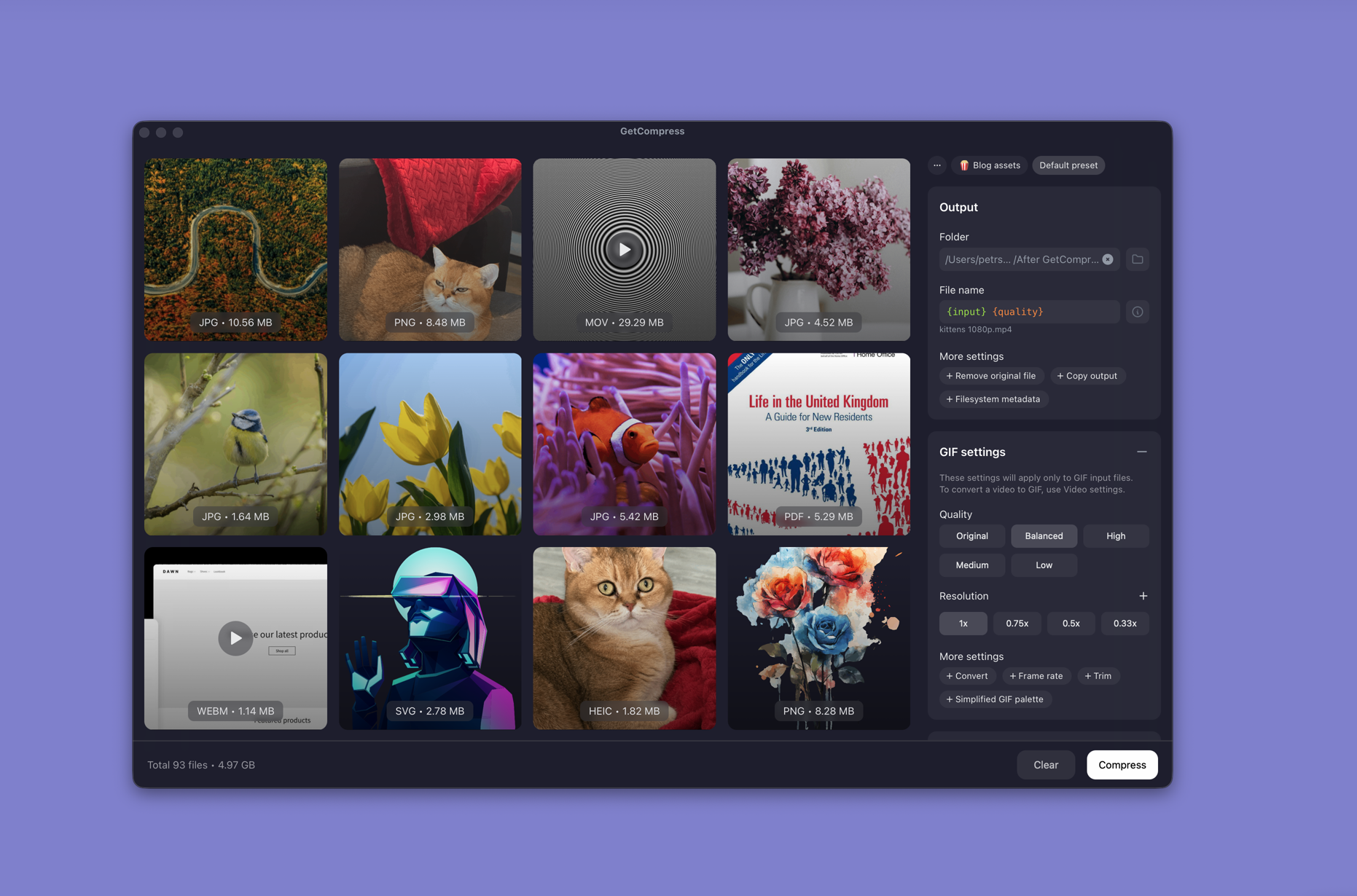
- Drop FLAC files or a whole folder into GetCompress .
- Choose MP3 output and set quality or bitrate.
- Spot-check one track, then export.
Processing stays on your PC. Save presets such as “client MP3 192k” vs “speech MP3 128k”. Export M4A when the recipient accepts AAC.
Method 2: Convert with FFmpeg
Best for: Scripts, exact flags, and one-off PowerShell batches.
Install FFmpeg with winget if needed:
winget install --id Gyan.FFmpeg -eSingle file:
ffmpeg -i track.flac -codec:a libmp3lame -q:a 2 track.mp3Batch every FLAC in a folder:
mkdir mp3-out
Get-ChildItem *.flac | ForEach-Object {
 ffmpeg -i $_.Name -codec:a libmp3lame -q:a 2 "mp3-out\$($_.BaseName).mp3"
}
Constant bitrate when a spec sheet lists an exact number:
ffmpeg -i track.flac -codec:a libmp3lame -b:a 192k track.mp3Listen to one output file before you batch. Sharp cymbals and sibilance show low-bitrate problems first.
Limitation: You maintain the commands yourself.
Method 3: Media Player for playback only
Best for: Confirming a FLAC file plays before you decide to convert.
Media Player on Windows 11 plays many FLAC files but does not export MP3. There is no built-in FLAC to MP3 menu like Print to PDF for documents.
Limitation: Playback only. Use Method 1 or 2 for conversion.
Which method should you use
| Situation | Start here |
|---|---|
| Album folders, presets, files you send often | GetCompress |
| Scripts or exact encoder flags | FFmpeg |
| Confirm the file opens | Media Player, then Method 1 or 2 |
When FFmpeg alone is enough
FFmpeg can finish a single album when you already know the flags and do not need a reusable UI preset.
GetCompress also helps when the same bitrate recipe repeats weekly, when mixed audio folders land in one queue, or when you want local processing without rewriting PowerShell loops. It does not replace a DAW. After conversion, if MP3 files are still too large, see compress MP3 on Windows without touching FLAC masters. For Mac, see FLAC to MP3 on Mac .
- Compress Audio Files on WindowsCompress audio on Windows with GetCompress, Clipchamp, or FFmpeg. Export M4A or MP3 for podcasts, lectures, and upload limits.
- Convert WAV to MP3 on WindowsConvert WAV to MP3 on Windows with GetCompress or FFmpeg. Keep WAV masters and export smaller share copies for email, LMS, and SharePoint uploads.
- Convert M4A to MP3 on WindowsConvert M4A to MP3 on Windows with GetCompress, FFmpeg, or a trimmed Clipchamp source. Export MP3 when a form or device rejects AAC.
- Convert FLAC to MP3 on MacConvert FLAC to MP3 on Mac with GetCompress, FFmpeg, or afconvert for M4A when MP3 is not required. Keep FLAC masters.